
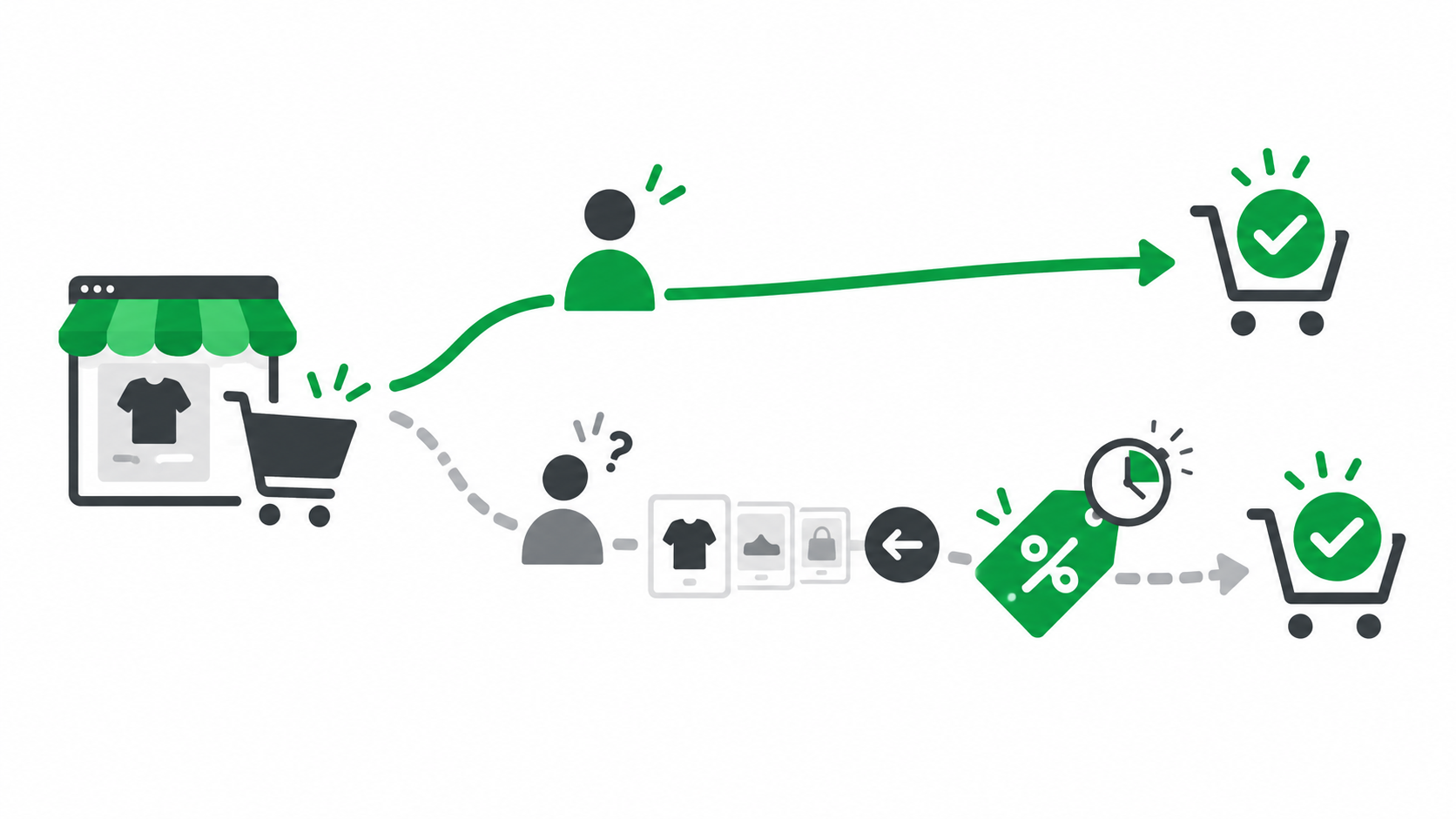

Picture two people on the same Shopify store at the same moment. The first one knows what she wants. She puts a jacket in her cart and walks straight to checkout. The second one is not so sure. He opens three product pages, checks the size chart, reads the shipping policy, and starts drifting toward the back button.
Most stores treat these two people exactly the same. Both see the same 15% pop-up. One of them needed a small push. The other just got money off a purchase she was already going to make.
Growth Suite exists for this gap. It is a Shopify app that watches how each visitor shops. Ready buyers see nothing at all. Only the shopper who is about to leave gets a personal, time-limited offer.
I think this company is worth a close look for one reason. It questions a rule the discount world rarely touches: the idea that more discounts always mean more sales. Let’s break it down.
The Discount Leak Nobody Tracks
Start with a number worth sitting with. Shopify puts the average store conversion rate at 2.5% to 3%. So about 97 out of every 100 visitors leave with nothing. Stores pay real money to win those visits, then try to save them with discounts.
That rescue costs more than it looks. Every sitewide code also lands on people who would have paid full price. On your dashboard, the sale looks like a win. An order came in, a code was used. What the dashboard does not show is the margin you handed to a buyer who never asked for it.
And the damage grows over time. Run sitewide codes often enough and customers learn the game. They add to cart, leave, and wait for your next email. Little by little, your discount becomes your real price.
This is the pain Growth Suite goes after. Most stores don’t have a discount problem. They have a targeting problem.
A Founder Who Started With Psychology, Not Code
Growth Suite comes out of Istanbul. Its founder, Muhammed Tüfekyapan, started a consulting practice called Growth Hacking Studio back in 2017. His background is behavioral psychology and content marketing, not discount software. He began building Growth Suite in 2019, and the app went live on the Shopify App Store in November 2020.
The core idea is easy to picture. Think of a good salesperson in a physical store. She never offers a deal to someone already walking to the register. She watches for the shopper who picks up a product, puts it down, and turns toward the door. Then she makes one offer, to that person, at that moment. Growth Suite is an attempt to rebuild that salesperson in software.
If you have read this site’s Growth Psychology playbook, you will recognize the move. Take a real human bias, but aim it only at the person who needs it.
The company is still founder-led. Muhammed builds the product himself, down to the Shopify Functions code, and he answers merchants directly. App Store reviews thank him by name. That is rare in this category.
How Growth Suite Works: Watch, Detect, Offer
The product does three things.
It watches. From the first page view, Growth Suite tracks what a visitor does. Pages opened, time on each page, products viewed, items added to cart, even mouse movement.
It detects. Those signals turn into a live purchase-intent score for every visitor. A high score marks a “dedicated buyer” who is going to purchase anyway. Growth Suite never shows that person an offer. A lower score marks the hesitant shopper: interested, but likely to leave.
It offers. The hesitant shopper gets a unique, single-use discount code with a real time limit. The offer shows up inside the store as a clean timer and native offer boxes, styled with the store’s own fonts and colors. Product pages show the old price crossed out next to a live countdown. The cart repeats the savings. At checkout, the code is already applied. When the timer ends, the code is deleted, and the same visitor sees no new offer for seven days.
The size of the offer moves with intent too. The merchant sets a range, say 5% to 15%. A warm visitor gets a small nudge. A visitor who is slipping away gets a bigger reason to stay. Products or whole collections with thin margins can be excluded, so they never get discounted at all.
The cheapest discount is the one you never had to give.
Real Urgency, Not Theater
Countdown timers have a bad reputation, and honestly, they earned it. Plenty of stores run fake timers that restart when the page reloads. Shoppers notice. Once they catch one fake deadline, they stop trusting the next ten.
Growth Suite ties its timers to real codes. When the clock hits zero, the discount leaves the cart and the code stops working. That keeps the urgency honest, and honest urgency keeps working. Kahneman and Tversky showed that losses feel roughly twice as strong as equal gains. But loss aversion only works when the loss is real. A fake deadline is a trick. A real one is just information.
The Math of a Wasted Discount
A quick example shows what is at stake. Say your store takes 1,000 orders a month at an average of $80. You run a sitewide 15% code, so every order gives up $12.
Now assume half of those buyers would have paid full price anyway. That is 500 orders times $12, or $6,000 a month given away for nothing. Over a year, it adds up to $72,000.
Growth Suite works on both sides of that math. It keeps full price from ready buyers, so that margin stays in your business. And it spends your discount budget only where it can change a decision: on the visitor who was about to walk away. This is value capture at its smallest scale. The question is not how much value your store creates. It is how much of it you keep.
The company’s case studies point the same way. Gelin Diamond, a jewelry store that used to hand out codes through pop-ups, reported a 5.3% increase in conversion rate after switching. Its owner went on to use the app in his other stores. Golden Gilt reported a 4.9% increase, and My Great Canvas reported 5.7%. These are the company’s own figures, so take them with a grain of salt. Still, three different stores moving the same direction is a decent sign.
Selling Through the Shopify App Store
Growth Suite does not need to outspend bigger apps. Its installs come through the place merchants already go to find tools. Growth Suite on the Shopify App Store carries the Built for Shopify badge. Shopify gives that badge to apps that meet its highest standards for performance, design, and integration. At the time of writing, the listing shows a 4.9 rating from 54 reviews, an interface in six languages, and a free trial.
The badge does more work than you might guess. Merchants are wary of apps that slow down the store or break the theme. Growth Suite loads its script asynchronously, needs no theme edits, and installs in minutes. Each detail removes one more reason to say no.
The footprint today: more than 300 stores in over 40 countries. That is not viral growth. It is steady platform-driven distribution. Borrow the platform’s reach, then earn trust one install at a time.
From One Feature to a Full Suite
Growth Suite started with timed offers for hesitant visitors. Over the years, the “suite” part of the name became real. Today the app also covers:
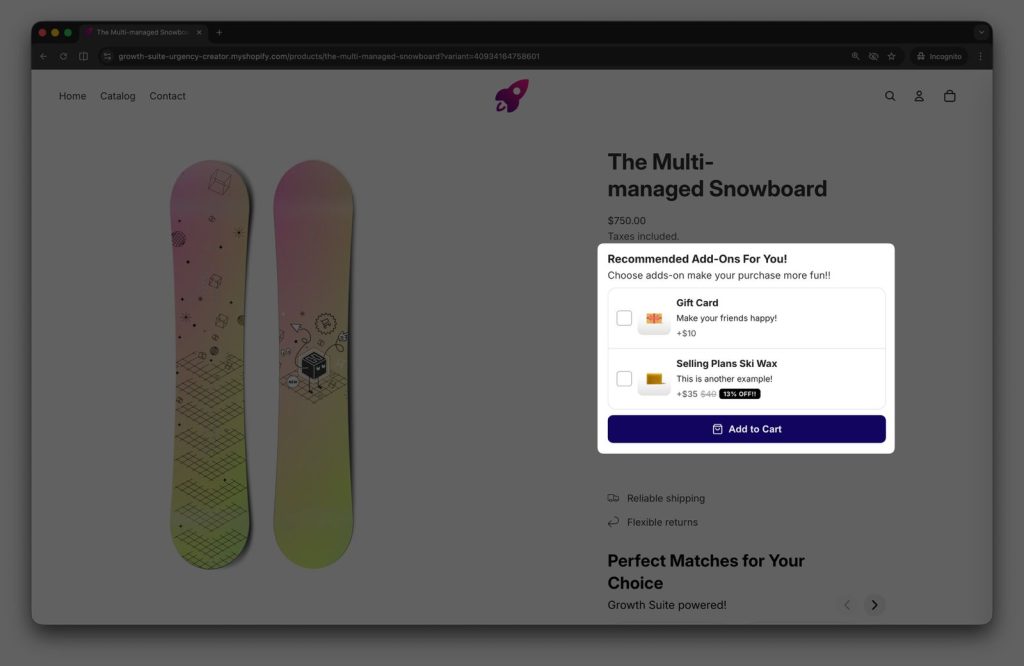
- One-click post-purchase upsells, shown after payment and before the thank-you page.
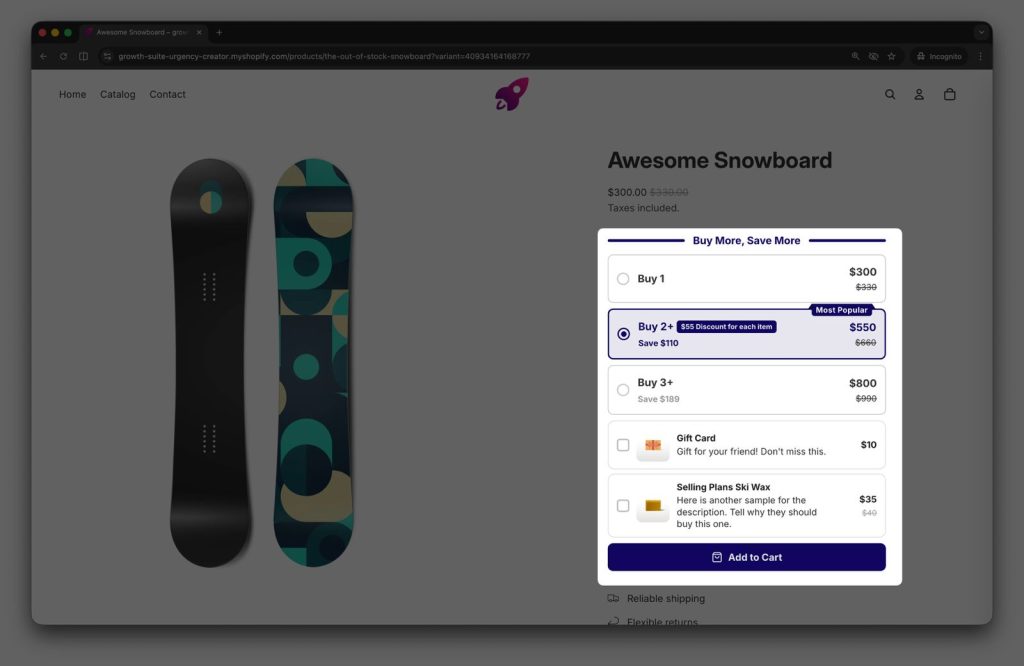
- Volume discounts and quantity breaks for products people buy in multiples.
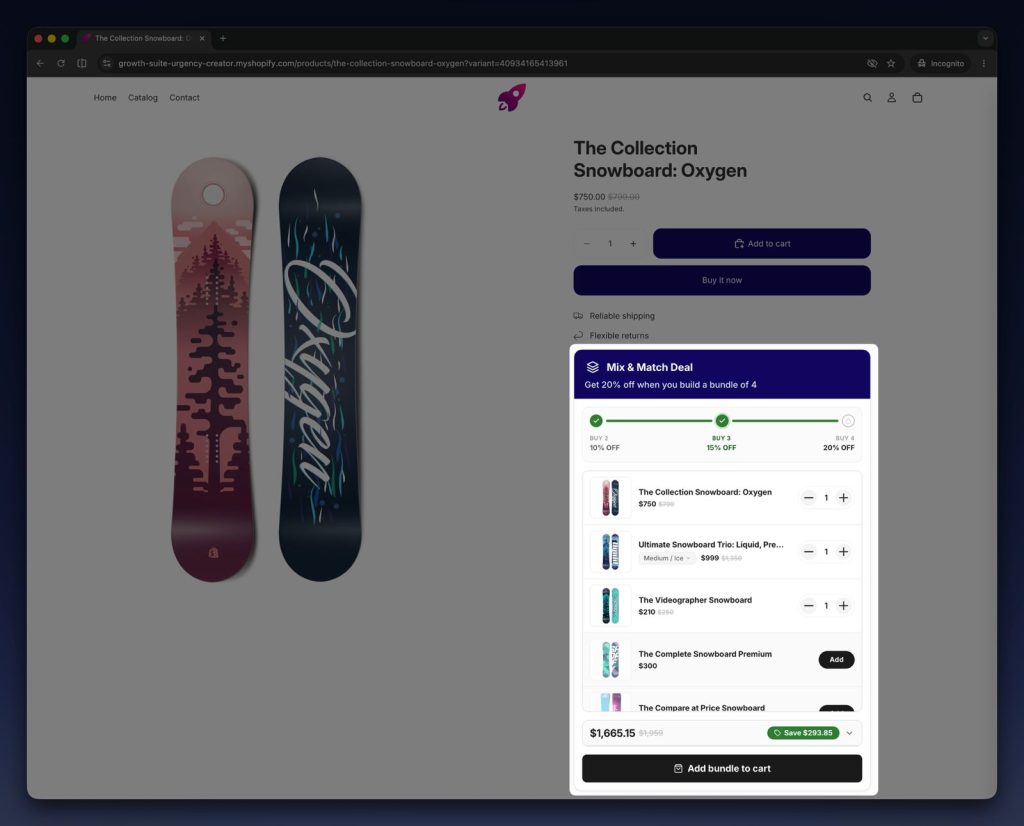
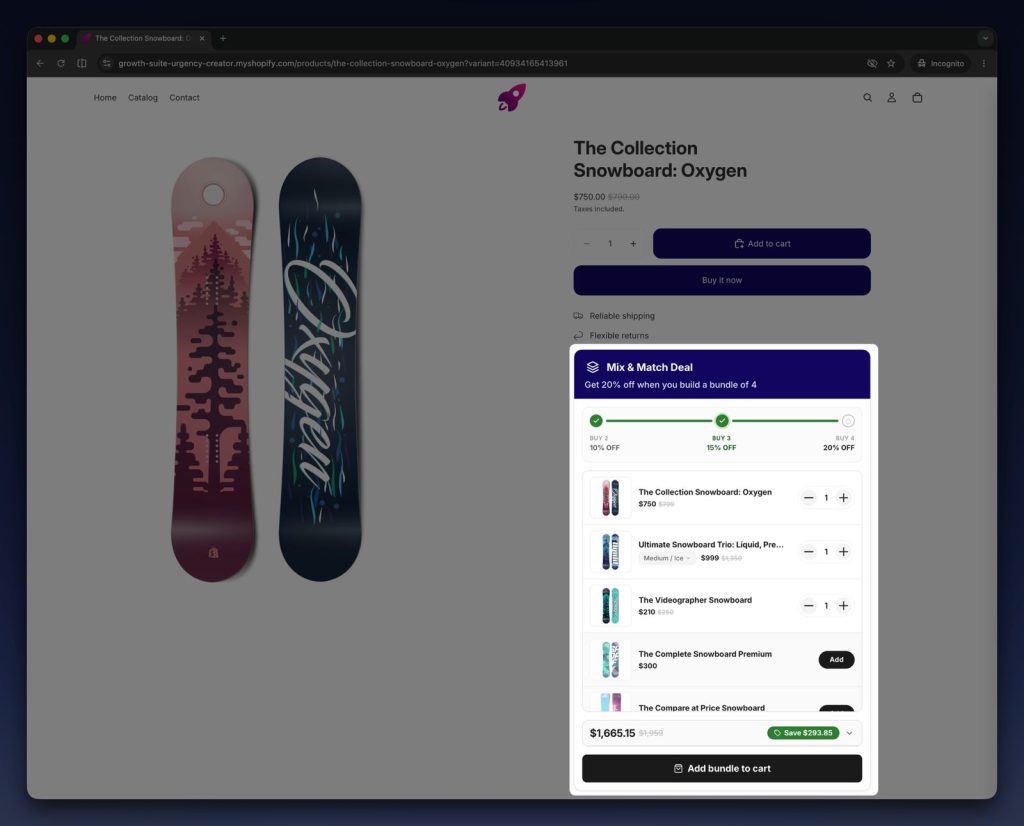
- Bundles, both fixed bundles and mix-and-match.
- Free gifts with purchase, with spend tiers that each unlock a set of gifts the customer picks from.
- Funnel and product reports that show where shoppers drop off and which products truly sell.
- A/B testing for discount rates and offer lengths.
This is textbook land-and-expand. The first feature earns trust by recovering lost sales. The next ones raise order value inside the same install. For the merchant, turning on a module is easier than adding yet another app. For Growth Suite, each module is a reason to move up a plan, with no new sales cycle needed.
Why Merchants Stay: The Quiet Moat
Every month on Growth Suite makes the setup harder to leave. A merchant tunes discount ranges, builds exclusion lists for low-margin products, sets up post-purchase funnels, and learns from months of reports. Switching means starting all of that from zero.
There is a softer moat too: trust. Review after review praises fast, personal support, often from the founder himself. In a market full of look-alike discount apps, that reputation is hard to copy. If you read the PallasMark breakdown on this site, the pattern will look familiar. An unglamorous problem, solved deeply, with an edge that grows over time.
Growth Suite vs. Other Ways to Convert Hesitant Shoppers
To be fair, merchants have other options. Here is the honest lineup.
Sitewide sales are easy to launch and easy to measure. They also discount every buyer, including the ones who needed no help at all.
Pop-up coupon apps collect emails and push a code at everyone who lands. They work, but they teach shoppers to expect a code on every visit.
Fake countdown timers create a short spike in sales and a long problem with trust.
Abandoned cart emails only reach shoppers who left an email and made it to the cart. Baymard Institute puts average cart abandonment at about 70%, and many visitors leave before they add anything at all.
Doing nothing keeps margins safe and lets hesitant shoppers walk out every day.
Against each of these, Growth Suite’s position is clear. More targeted than a sitewide sale. Quieter than a pop-up. More honest than a fake timer. Earlier than a cart email. It does not replace your email flows. It reaches the visitor before they are gone.
What the First 90 Days Look Like
Week one: install from the App Store, match the offer to your brand colors, set a discount range, and exclude thin-margin products. That takes minutes, not a project. Month one: read the funnel report to see where shoppers drop off and how offers change the numbers. Month three: A/B test discount rates and timer lengths. Then add post-purchase upsells or volume offers once the core offer is tuned.
The mistake to avoid is a wide discount range on day one. Start narrow, prove the lift, then widen. A discount engine is only as smart as the limits you give it.
Growth Suite Pricing and Limits
No review is complete without the other side. Plans start at $139 a month and scale with monthly unique visitors, so Growth Suite is built for stores with real traffic. A very small store may not have enough visits to justify it yet. Behavioral scoring also needs behavior to read. The more sessions a store has, the better the signal.
And no discount, however smart, can fix a weak product, poor photos, or a price that is simply too high. Growth Suite answers one question very well: who should get an offer, and when. It cannot make a store worth buying from in the first place.
How to Choose a Shopify Discount App: A Scorecard
If you are comparing tools in this space, score six areas.
| Criterion | What good looks like | Red flag |
|---|---|---|
| Targeting | Offers based on live intent, ready buyers excluded | Same code for every visitor |
| Urgency | Real expiry, code removed when time runs out | Timer restarts on reload |
| Margin control | Min and max range, product and collection exclusions | One fixed percent on everything |
| Design | Native to the theme, styled like the brand | Generic overlays that clash with the store |
| Speed | Async script, no theme edits | Render-blocking code in theme files |
| Measurement | Funnel reports and A/B tests | Vague “revenue influenced” claims |
Whichever tool you pick, run a trial on real traffic before any long commitment. Then track one number: profit per visitor, before and after. Everything else is noise.
Lessons for SaaS Founders
- Sell the discount you don’t give. Growth Suite’s real pitch is not more discounts. It is protected margin.
- Make urgency honest. Real deadlines keep working. Fake ones burn trust.
- Use the platform’s front door. A trusted badge inside the platform’s own store can beat paid reach.
- Expand inside the same install. Each new module grows revenue without a new sales cycle.
Growth Suite FAQ
How does Growth Suite know which visitors are hesitant?
It scores each visitor in real time from behavior: pages viewed, time on page, products opened, cart actions, and mouse movement. Visitors with strong buying signals get no offer. Visitors who show interest but look likely to leave get a personal, time-limited one.
Will shoppers learn to wait for a discount?
That is the risk with blanket codes, and it is why Growth Suite limits offers. Codes are unique and single use. They disappear when the timer ends, and the same visitor will not see another offer for seven days. Ready buyers never see one at all.
Does Growth Suite slow down a Shopify store?
The script loads asynchronously, so it does not block the page, and setup needs no theme edits. Performance is also one of the areas Shopify checks before it grants the Built for Shopify badge.
How much does Growth Suite cost?
Plans start at $139 a month and scale with monthly unique visitors. There is a 14-day free trial, so you can test it on real traffic before you pay anything.
Which stores is Growth Suite a good fit for?
Stores with steady traffic and a real share of browsers who leave without buying. Stores that run frequent sitewide sales have the most to gain, because they have the most margin to win back.
Continue Reading: Growth Psychology & Success Stories
This article is part of the Success Stories series. Related reading: